The Internet is Global. Laws are Local.
Regulating the Internet. It's a sensitive topic for many people, with great passion and powerful reasons on both sides. Government legislation, international talks, popular uprisings, anonymous reprisals and more make the issue a tangled mess. But the Internet is a powerful tool, and a growing force in shaping the world as we experience it. We will be struggling with the question of regulation for years to come, and the decisions we make will have wide-ranging consequences.
The Internet is a unique realm of interaction. In no other system can information, ideas, money, products, skills, education, and much more be shared with equivalent ease and speed over unlimited geographical distance, cultural barriers, and national boundaries. Constructs such as borders that so fundamentally define much of modern society have no representation on the Internet. A site created by a woman in France, hosted by a server in the United States, maintained by a man in India, is available with a handful of keystrokes by a child in China, the Ukraine, South Africa. The Internet gives us unprecedented connection to other people, unfettered by the limitations of physical proximity or prejudice.
However, the Internet is only a tool. The content generators and the content consumers are all people. And people, for all of human history, have hurt each other. Modern society functions through the frame that certain ways of hurting other people are unacceptable. Murder is punished, theft is illegal. The massive institutions that we use daily, such as banks, public transit, electric grids, are only feasible because we trust that strangers we have never met will follow societal rules. And we only have this trust because we believe people will be punished if they violate the rules. But the laws are different in each country. That is not much of a problem if you are in only one country, beholden to its laws. However, using the Internet you can be on sites from a dozen different countries, in a span of minutes, at the press of a button.
Internet regulation has to balance these different issues. Openness and connectivity push against upholding laws. Different nations have different conceptions of what is legal and what should be punished, complicated by the varying moral structures each upholds. The global nature of the Internet makes it difficult to identify clear jurisdictions, let alone protect citizens from crime from other countries.
This website investigates the issues and interests at play, the proposed solutions, and the possible pitfalls.
The Internet is a unique realm of interaction. In no other system can information, ideas, money, products, skills, education, and much more be shared with equivalent ease and speed over unlimited geographical distance, cultural barriers, and national boundaries. Constructs such as borders that so fundamentally define much of modern society have no representation on the Internet. A site created by a woman in France, hosted by a server in the United States, maintained by a man in India, is available with a handful of keystrokes by a child in China, the Ukraine, South Africa. The Internet gives us unprecedented connection to other people, unfettered by the limitations of physical proximity or prejudice.
However, the Internet is only a tool. The content generators and the content consumers are all people. And people, for all of human history, have hurt each other. Modern society functions through the frame that certain ways of hurting other people are unacceptable. Murder is punished, theft is illegal. The massive institutions that we use daily, such as banks, public transit, electric grids, are only feasible because we trust that strangers we have never met will follow societal rules. And we only have this trust because we believe people will be punished if they violate the rules. But the laws are different in each country. That is not much of a problem if you are in only one country, beholden to its laws. However, using the Internet you can be on sites from a dozen different countries, in a span of minutes, at the press of a button.
Internet regulation has to balance these different issues. Openness and connectivity push against upholding laws. Different nations have different conceptions of what is legal and what should be punished, complicated by the varying moral structures each upholds. The global nature of the Internet makes it difficult to identify clear jurisdictions, let alone protect citizens from crime from other countries.
This website investigates the issues and interests at play, the proposed solutions, and the possible pitfalls.
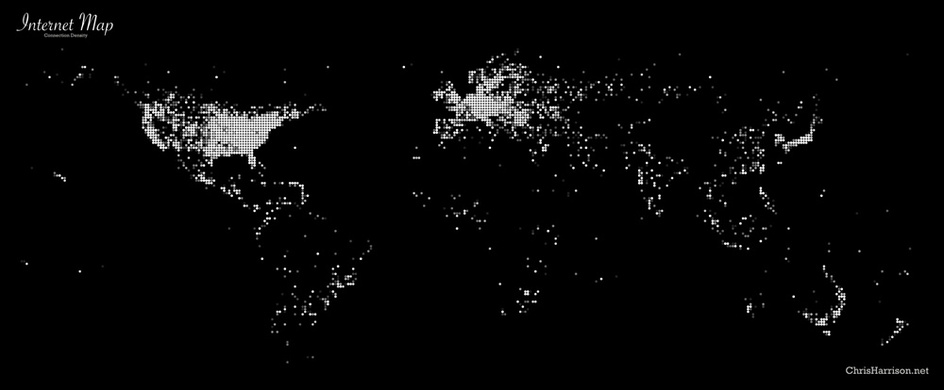
Visualization of Internet connection density across the world. (1)
About This Site
This site was created by Daniel Jackoway, Sarah Sterman, and Grant Mathews as a final project for Stanford CS181: Computers, Ethics, and Public Policy.
November-December 2012.
November-December 2012.