World Conference on International Telecommunications

WCIT logo (25)
International Telecommunications Union
Dubai, United Arab Emirates, 3-14 December 2012
Right now (December 3-14, 2012), the World Conference on International Telecommunications is being held in Dubai. The International Telecommunications Union (ITU) is "the United Nations specialized agency for information and communication technologies," and is running the conference (27). The purpose is to discuss updating a global treaty on telecommunication regulation, especially related to the rise of new technologies like the Internet and mobile phones.
Like most things addressing Internet regulation, the conference is under heated discussion, even before it started. The United States, European Union, and Australia have come out against it on various economic and political grounds, as has Google, which argues the conference excludes key Internet figures, including companies and developers. On December 5, the United States House of Representatives unanimously passed a resolution opposing UN control of the Internet. It passed in September in the Senate, also unanimously, surprising for anything on its way through the US Congress (36). However, other countries and corporations support revisions, including European telecom companies, Russia, China and multiple African and Arab nations (28).
The supporters of revisions see increased regulation as a path towards greater access. Dr. Hamadoun Toure, secretary-general of the ITU, says, "the brutal truth is that the internet remains largely [the] rich world's privilege...ITU wants to change that" (29). The European Telecommunications Network Operators' Association claims changing the business model of providing Internet will increase "incentive to invest in network infrastructure" (29). Infrastructure, especially in developing countries, is certainly key to access, and supports the ITU's mission to ensure "the free flow of information around the world, promoting affordable and equitable access for all and laying the foundation for ongoing innovation and market growth" (30). However, the statement that the new system will help rather than hinder is questionable, especially because it is the companies that stand to gain the most from the new fee structures that support it.
The other side sees the suggested "sender pays" business model (31) -- where companies are responsible for paying fees to telecoms to transmit their content -- as a danger to the future of the Internet. "The reason that the internet has been so successful and has already spread as far as it has, as fast as it has, is that it hasn't been controlled by a bureaucratic government body in which only other governments could vote," writes TechDirt. This is a common opinion, and is being voiced over and over in the face of the ITU conference. "The internet works, it doesn't need to be regulated by ITR treaty. If it ain't broke, don't fix it," tweeted the VP of the EU commission (33).
Beyond the economics, one leaked proposal put forward by Russia is that "member states shall have equal rights to manage the internet, including in regard to the allotment, assignment and reclamation of internet numbering, naming, addressing and identification resources and to support for the operation and development of basic internet infrastructure" (35). This is currently managed by non-profits in the United States, which "are officially under the remit of the US Department of Commerce, but in effect operate at arm's length from the US government" (30). Fears about the new proposal include "open[ing] the door to more censorship" (29), and the more extreme worry about "a splintering of the internet," expressed by Alan Woodward, a computing professor in Surrey. He says, "if people start going off and doing their own things in term of naming conventions and net addresses you could end up with different parts of the internet being unable to send traffic to each other…It would be the online equivalent of not being able to make a telephone call from one nation to another" (30).
While the WCIT is unlikely to make any revisions, since a decision can be prevented by any one country disagreeing and there are already a handful strongly opposed, it brings up many of the issues at stake in international Internet regulation, and reminds us that it is an active issue.
Dubai, United Arab Emirates, 3-14 December 2012
Right now (December 3-14, 2012), the World Conference on International Telecommunications is being held in Dubai. The International Telecommunications Union (ITU) is "the United Nations specialized agency for information and communication technologies," and is running the conference (27). The purpose is to discuss updating a global treaty on telecommunication regulation, especially related to the rise of new technologies like the Internet and mobile phones.
Like most things addressing Internet regulation, the conference is under heated discussion, even before it started. The United States, European Union, and Australia have come out against it on various economic and political grounds, as has Google, which argues the conference excludes key Internet figures, including companies and developers. On December 5, the United States House of Representatives unanimously passed a resolution opposing UN control of the Internet. It passed in September in the Senate, also unanimously, surprising for anything on its way through the US Congress (36). However, other countries and corporations support revisions, including European telecom companies, Russia, China and multiple African and Arab nations (28).
The supporters of revisions see increased regulation as a path towards greater access. Dr. Hamadoun Toure, secretary-general of the ITU, says, "the brutal truth is that the internet remains largely [the] rich world's privilege...ITU wants to change that" (29). The European Telecommunications Network Operators' Association claims changing the business model of providing Internet will increase "incentive to invest in network infrastructure" (29). Infrastructure, especially in developing countries, is certainly key to access, and supports the ITU's mission to ensure "the free flow of information around the world, promoting affordable and equitable access for all and laying the foundation for ongoing innovation and market growth" (30). However, the statement that the new system will help rather than hinder is questionable, especially because it is the companies that stand to gain the most from the new fee structures that support it.
The other side sees the suggested "sender pays" business model (31) -- where companies are responsible for paying fees to telecoms to transmit their content -- as a danger to the future of the Internet. "The reason that the internet has been so successful and has already spread as far as it has, as fast as it has, is that it hasn't been controlled by a bureaucratic government body in which only other governments could vote," writes TechDirt. This is a common opinion, and is being voiced over and over in the face of the ITU conference. "The internet works, it doesn't need to be regulated by ITR treaty. If it ain't broke, don't fix it," tweeted the VP of the EU commission (33).
Beyond the economics, one leaked proposal put forward by Russia is that "member states shall have equal rights to manage the internet, including in regard to the allotment, assignment and reclamation of internet numbering, naming, addressing and identification resources and to support for the operation and development of basic internet infrastructure" (35). This is currently managed by non-profits in the United States, which "are officially under the remit of the US Department of Commerce, but in effect operate at arm's length from the US government" (30). Fears about the new proposal include "open[ing] the door to more censorship" (29), and the more extreme worry about "a splintering of the internet," expressed by Alan Woodward, a computing professor in Surrey. He says, "if people start going off and doing their own things in term of naming conventions and net addresses you could end up with different parts of the internet being unable to send traffic to each other…It would be the online equivalent of not being able to make a telephone call from one nation to another" (30).
While the WCIT is unlikely to make any revisions, since a decision can be prevented by any one country disagreeing and there are already a handful strongly opposed, it brings up many of the issues at stake in international Internet regulation, and reminds us that it is an active issue.
Syria
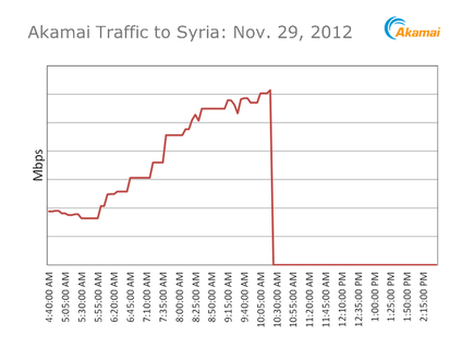
Taking Syria offline (44)
On November 29, during heavy fighting around Damascus, the Syrian Internet shut off. Both sides in the civil war have blamed each other, but outside of Syria the consensus is that it was the action of Assad’s regime (37, 38).
There are four cables carrying Internet traffic out of Syria, but the Syrian Telecommunications Establishment, the only provider of Internet service, is controlled by the government (37, 39). Shutting off the Internet cripples communications for both sides, however the government has access to alternative forms of communication, while the rebels have been leaning heavily on the Internet to share information and media about the situation in Syria (41).
This is not the first time Syria has cut off its Internet. In 2011, there was a similar blackout during unrest after the protests in Egypt and Tunisia (40). During the civil war this year, there have been regional blackouts before engagements, and at least two others on a national scope (38).
Extremely varied groups have taken stances against the shut-off. Human rights groups such as Amnesty International fear that the Internet blackout heralds war crimes and crimes against humanity, and warn of accountability (42). Anonymous has made reprisals for the shut-off, hacking Syrian government sites hosted outside of the country, and those of government sympathizers (43).
The Internet came back up after two days, but with the war ongoing, the future is uncertain. Moreover, continuing to restrict Internet access as a weapon and as a way to hide unacceptable violence puts another ethical question on the table of Internet regulation.
There are four cables carrying Internet traffic out of Syria, but the Syrian Telecommunications Establishment, the only provider of Internet service, is controlled by the government (37, 39). Shutting off the Internet cripples communications for both sides, however the government has access to alternative forms of communication, while the rebels have been leaning heavily on the Internet to share information and media about the situation in Syria (41).
This is not the first time Syria has cut off its Internet. In 2011, there was a similar blackout during unrest after the protests in Egypt and Tunisia (40). During the civil war this year, there have been regional blackouts before engagements, and at least two others on a national scope (38).
Extremely varied groups have taken stances against the shut-off. Human rights groups such as Amnesty International fear that the Internet blackout heralds war crimes and crimes against humanity, and warn of accountability (42). Anonymous has made reprisals for the shut-off, hacking Syrian government sites hosted outside of the country, and those of government sympathizers (43).
The Internet came back up after two days, but with the war ongoing, the future is uncertain. Moreover, continuing to restrict Internet access as a weapon and as a way to hide unacceptable violence puts another ethical question on the table of Internet regulation.
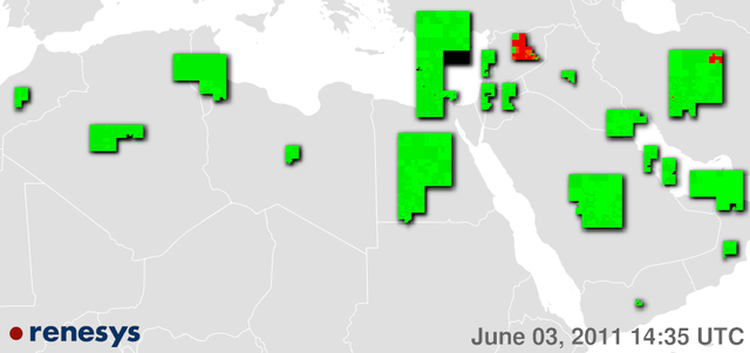
Representation of network prefix connectivity in the Middle East during Syrian blackout in 2011 (red is unreachable). Block size is based on Internet presence in each country. (40)