Cyberlibertarianism
Cyberlibertarianism, and related philosophies such as Internet exceptionalism, support no or limited regulation of the Internet. Documents like the Declaration of the Independence of Cyberspace (2) declare the Internet a new world, a place where governments and their laws have no place. The Internet should be a place of “liberty of conscience, thought, opinion, speech and expression,” as well as “contract, innovation, and exchange” (3).
Cyberlibertarians approach issues like child safety by putting the burden on parents, and see privacy regulations as dangerous for their potential impacts on free speech and growth. They focus on “user empowerment” and “industry self-regulation” to manage privacy instead (3). They also emphasize the fast growth of technology, that it is too fast for governments to have a hope to regulate (3).
Anti-cyberlibertarians claim that the Internet is not so different from other types of communication. They believe that traditional regulatory bodies can be effective in cyberspace, and that certain rules cannot be enforced through private consensus, and so need regulation. In the well-known article “Against Cyberanarchy,” Jack Goldsmith at the University of Chicago points out that the Internet can cause “real-world harms” and that governments have a “legitimate interest” in preventing harm through regulation (4).
In making choices about regulating the Internet, people rely on a mental frame of what the Internet is. To cyberlibertarians, it is an unprecedented new realm, a world separate from the physical, where there is a citizenry who are separate from that of any nation. The Declaration of the Independence of Cyberspace is full of “we” and “our,” suggesting a coherent group of Internet residents. There is no one who actually lives solely in the Internet, but the implication is that whatever happens in cyberspace is separate and cannot be associated with the individual’s physical identity. To anti-cyberlibertarians, the Internet is an aspect of the rest of the world, and all activities and identities in cyberspace are only actions and facets of the real people. To make decisions on Internet jurisdiction and regulation, we need to be aware of the frame we are working within, and be ready to challenge it to understand the other side.
Cyberlibertarians approach issues like child safety by putting the burden on parents, and see privacy regulations as dangerous for their potential impacts on free speech and growth. They focus on “user empowerment” and “industry self-regulation” to manage privacy instead (3). They also emphasize the fast growth of technology, that it is too fast for governments to have a hope to regulate (3).
Anti-cyberlibertarians claim that the Internet is not so different from other types of communication. They believe that traditional regulatory bodies can be effective in cyberspace, and that certain rules cannot be enforced through private consensus, and so need regulation. In the well-known article “Against Cyberanarchy,” Jack Goldsmith at the University of Chicago points out that the Internet can cause “real-world harms” and that governments have a “legitimate interest” in preventing harm through regulation (4).
In making choices about regulating the Internet, people rely on a mental frame of what the Internet is. To cyberlibertarians, it is an unprecedented new realm, a world separate from the physical, where there is a citizenry who are separate from that of any nation. The Declaration of the Independence of Cyberspace is full of “we” and “our,” suggesting a coherent group of Internet residents. There is no one who actually lives solely in the Internet, but the implication is that whatever happens in cyberspace is separate and cannot be associated with the individual’s physical identity. To anti-cyberlibertarians, the Internet is an aspect of the rest of the world, and all activities and identities in cyberspace are only actions and facets of the real people. To make decisions on Internet jurisdiction and regulation, we need to be aware of the frame we are working within, and be ready to challenge it to understand the other side.
National Regulation of the Internet through Censorship
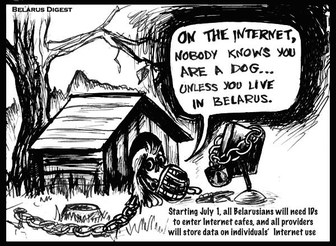
Belarusian political cartoon from 2010 (6)
Different levels of censorship are used by countries across the globe. Censorship, while a bad word in the United States, is seen as necessary to the stability of the state in many other countries. In the face of the Internet’s mass of unrestricted content, these nations have turned to regulating it through various means within their own borders.
China and Vietnam are two examples on the severe end of the spectrum. China started out without much censorship, but after 2000, "as chat rooms and blogs pushed the boundaries of allowable dissent with a steady stream of criticism of government officials, it began to tighten control significantly” (5). In order to implement censoring, China employs monitors to police blogs, forums, and email, and requires web companies to do the same. Websites criticizing the government are taken down, and proxy services prohibited (54). People who violate the rules are prosecuted as an “intimidation strategy” (5). Vietnam uses similar tactics, and punishes “owners of cybercafés who permit searches of unauthorized websites by their clients” (5, 55), putting responsibility on the intermediaries as well as the consumers for illicit activities.
On the more moderate end of the spectrum, Brazil has forced ISPs to block content it finds “‘defamatory’ to the state” (5). Chile has focused on moral offenses and threats to public order, including, again, material that speaks against the state, such as Alejandra Matus’s expose on the judiciary (5, 56). Italy has “shut down websites critical of Catholicism” (5).
Even countries we might never think of as permitting censorship do to some extent. The United States has blocked child pornography sites and sites that egregiously violate copyright law, and Finland used a “list of proscribed child pornography sites” to block a website criticizing “government efforts to regulate the internet” (5). France and Germany block searches for Nazi materials (5).
Of course, there is censorship in traditional media, as well. Using a cyberlibertarian frame, however, the Internet has a special status. The ease of communication, the ability for individuals to create their own news media without relying on self-interested corporations or governments, make the Internet a more powerful forum for change, as the world saw clearly in 2011 with the Arab Spring. Censorship clamps down on the kinds of discourse that can incite change; even seemingly reasonable desires to maintain public order can easily turn into enforcing an undesirable status quo on an unwilling population.
Yet from the other side, the governments do have a responsibility to protect their citizens. Whether that is from child pornography, from copyright violations, or from defamation depends on the particular beliefs and needs of the government. Whether a particular form of censorship is justified or oppressive depends on the perspective of the viewer, and makes any consensus on the issue unlikely.
China and Vietnam are two examples on the severe end of the spectrum. China started out without much censorship, but after 2000, "as chat rooms and blogs pushed the boundaries of allowable dissent with a steady stream of criticism of government officials, it began to tighten control significantly” (5). In order to implement censoring, China employs monitors to police blogs, forums, and email, and requires web companies to do the same. Websites criticizing the government are taken down, and proxy services prohibited (54). People who violate the rules are prosecuted as an “intimidation strategy” (5). Vietnam uses similar tactics, and punishes “owners of cybercafés who permit searches of unauthorized websites by their clients” (5, 55), putting responsibility on the intermediaries as well as the consumers for illicit activities.
On the more moderate end of the spectrum, Brazil has forced ISPs to block content it finds “‘defamatory’ to the state” (5). Chile has focused on moral offenses and threats to public order, including, again, material that speaks against the state, such as Alejandra Matus’s expose on the judiciary (5, 56). Italy has “shut down websites critical of Catholicism” (5).
Even countries we might never think of as permitting censorship do to some extent. The United States has blocked child pornography sites and sites that egregiously violate copyright law, and Finland used a “list of proscribed child pornography sites” to block a website criticizing “government efforts to regulate the internet” (5). France and Germany block searches for Nazi materials (5).
Of course, there is censorship in traditional media, as well. Using a cyberlibertarian frame, however, the Internet has a special status. The ease of communication, the ability for individuals to create their own news media without relying on self-interested corporations or governments, make the Internet a more powerful forum for change, as the world saw clearly in 2011 with the Arab Spring. Censorship clamps down on the kinds of discourse that can incite change; even seemingly reasonable desires to maintain public order can easily turn into enforcing an undesirable status quo on an unwilling population.
Yet from the other side, the governments do have a responsibility to protect their citizens. Whether that is from child pornography, from copyright violations, or from defamation depends on the particular beliefs and needs of the government. Whether a particular form of censorship is justified or oppressive depends on the perspective of the viewer, and makes any consensus on the issue unlikely.
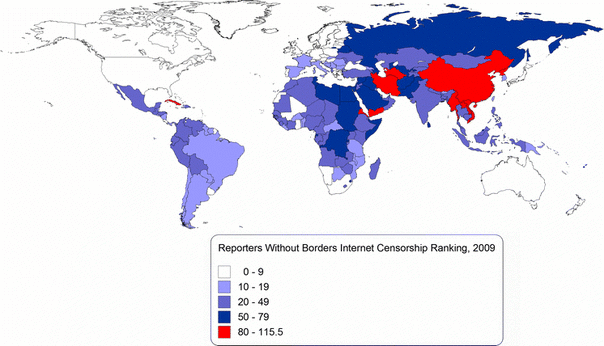
Internet censorship across the world (5)
Shutting Down the Internet
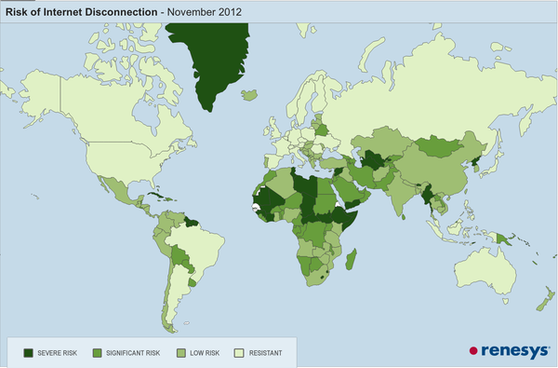
Risk is determined by number of ISPs with international connections. (9)
In February 2011, during the civil war in Libya, Gaddafi's government shut off the Internet. In the following days, hundreds of people were killed. (8)
The previous month, Egypt had shut off its own Internet, an "action unprecedented in Internet history" (7). First, this raises questions about human rights, both the right to the Internet itself and the possible abuses going on while communication is blacked out. When a government knows that its victims can publicize events to a global audience, the first step towards getting away with atrocities is to prevent that communication.
Second, when a nation excises itself from the broader Internet, there are consequences for every other Internet user. The Internet adheres to national boundaries only haphazardly. When the Libyan Internet shut off, it took out servers that global Internet services rely on. Redundancies kept domains like bit.ly (a US-based URL shortening service) running, despite having 2 of its 5 root servers in Libya (8). But a country registry that isn't updated will be cut off eventually.
There is no international regulation against Internet black outs. Countries that have significant censorship track closely to those countries that have a high capability to cut off their own Internet, often through centralized, government-controlled infrastructure (see maps). These countries support more power for individual nations over Internet content and access (see ITU conference), and would likely strongly reject any attempt to create more lenient international regulations on Internet access.
The previous month, Egypt had shut off its own Internet, an "action unprecedented in Internet history" (7). First, this raises questions about human rights, both the right to the Internet itself and the possible abuses going on while communication is blacked out. When a government knows that its victims can publicize events to a global audience, the first step towards getting away with atrocities is to prevent that communication.
Second, when a nation excises itself from the broader Internet, there are consequences for every other Internet user. The Internet adheres to national boundaries only haphazardly. When the Libyan Internet shut off, it took out servers that global Internet services rely on. Redundancies kept domains like bit.ly (a US-based URL shortening service) running, despite having 2 of its 5 root servers in Libya (8). But a country registry that isn't updated will be cut off eventually.
There is no international regulation against Internet black outs. Countries that have significant censorship track closely to those countries that have a high capability to cut off their own Internet, often through centralized, government-controlled infrastructure (see maps). These countries support more power for individual nations over Internet content and access (see ITU conference), and would likely strongly reject any attempt to create more lenient international regulations on Internet access.